
Horror, Occult, and Joy
An Interview with Demetra Cartsos from The Devastation
13 December 2025, Vienna, Austria
The Devastation is in some way the sensation of the Viennese and Austrian scene this year. The band is dedicated to expressing the darkness around and “within us” and defines their aesthetic proposal as occult rock/metal. After releasing their first single, “The Discipline of Death”, and participating in some band competitions, the teenager-formed band were playing at important rock and metal venues like B72, Café Carina, Flex,Szene, Viper Room, and Escape in Vienna or Club Vakuum in Graz, and being invited to festivals such as Blasphemy Over Villach, Dunkelhate Fest (Graz), and the mythic Doom Over Vienna, some of which we have covered here at State of Guitars. Just a few weeks ago, they released their second single, “Woman in Black Veil”, and are planning to record their first album soon. In this scheme, Demetra plays a fundamental role, being the frontwoman, singer, guitarist, and one of the composers and founders of the band.
I had the opportunity to hear The Devastation at the Doom Over Vienna this year and to personally meet Demetra on this occasion. After exchanging a few messages and thoughts, the idea of doing an on-site interview came up, of course, with the consent and support of her parents, as she is still a minor. What I present here is just an excerpt from a much longer interview, containing the elements we considered most interesting for the readers of State of Guitars. This is also why the interview does not have a clear greeting or goodbye at the end. But I can tell you in advance that it is totally worth it. We started talking about doom metal…
***
Foreigner: There are a few research papers about doom metal that say it is a niche within a niche. For example, in the big festivals, there is death metal, black metal, as well as thrash. But there is maybe one doom metal band, and most of the time, no doom bands.
Demetra: I know a few people that listen to metal, but none of them are really into doom metal. They’re more into the things that are new metal, symphonic metal, and stuff like that. For me, those things are not that interesting, I have to say. I feel like doom really, sort of, represents my life in a way. I’m very tied to it. I feel like it brings me comfort when I listen to it, especially as I’ve been getting a lot into Electric Wizard and Candlemass lately, it’s the whole guitar fuzz, it gives you a warm feeling, I have to say it reminds me of home.
“I feel like doom really, sort of, represents my life in a way. I’m very tied to it”
Foreigner: You were saying that Candlemas was an inspiration for you, in a way. Of course. There is another band, I know that Lucifer is also important for you.
Demetra: Very much, yes. I mean, I know their singer, Johanna, who’s also a very nice person, a very supportive person. I got to talk to her in Greece recently, when she played, she put me on the guest list which was a thrill. We talked a bit generally about how it is to be a woman in the music industry too and how she is really amazing at what she does. I know she’s been through a lot lately, the whole line-up changes and everything, but she stays very professional about it, and that’s something I look up to.
Foreigner: I know that you are really young at the moment, and I am not sure, but I suppose that there are some difficulties maybe, maybe not, for a female composer, a frontwoman in the scene.
Demetra: Well, definitely, yeah, I’ve heard from lots of people, but personally I haven’t really felt it yet and I’m very thankful for that. I haven’t been in a situation where people treated me different because I’m female. I’ve been more in situations where they’ve treated me otherwise because I am so young. I feel like people do not expect us to act so professionally if we are young. I mean, we are still at the very beginning of our journey but it doesn’t mean we don’t take it seriously.
“I’ve been more in situations where they’ve treated me otherwise because I am so young”
Foreigner: I read in another interview that you and Felix, the guitarist, are like a power duo in composing and so on. Does he also have a role in the songs?
Demetra: Very much so. Sometimes it’s just me, I write both the melody on the guitar and the lyrics but sometimes he writes all the music to the song and I write the vocal melody and the lyrics, so it really just depends on who brings the song to a rehearsal, both of us write songs and we both show up with the songs we write and work on them with the rest of the band. He and I work very well together. We had a band before this one that was actually inside of our school, a school band called Friday the 13th. Thanks to the support of our school we were given space and time to jam and songs would come from these jams, but I feel now, since forming The Devastation, it’s been more of I write something at home, he writes something at home and then we bring it to the rehearsal. I’d really enjoy if we would be able to write something together again, we just have to find the time.
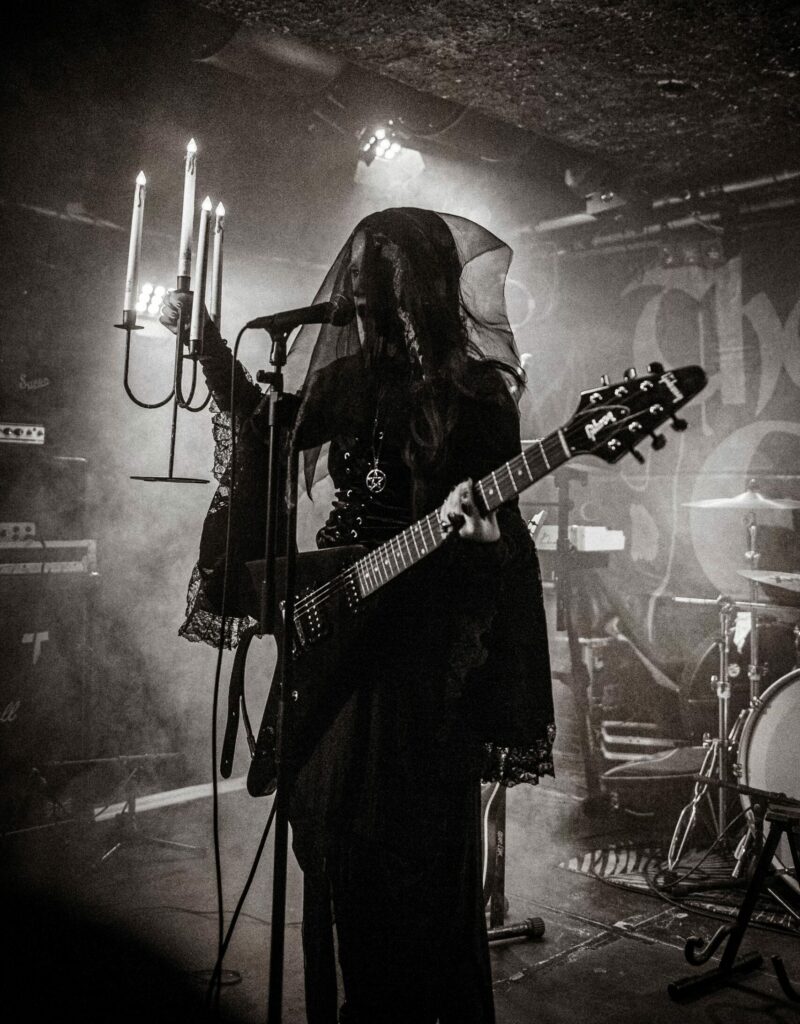
Foreigner: How did you come to the idea of The Devastation as a concept, like the kind of music that you do, the occult rock and metal, your performance with kind of gothic clothes and the veil. How did you come to these ideas?
Demetra: Well, it sort of took time to get to where it is right now. The first band that I really listened to that you could say is occult music was Ghost, and I have to say I prefer their earlier releases, like Opus Eponymous, Infestissumam and Meliora. I really enjoyed the aspect of the occult and the doom vibes. I really like horror movies too, I generally like things that are a bit spooky so I decided to put that into my music too. For the song “Woman in the Black Veil”, the inspiration came from a nightmare I had: I was eating with my band in a park and when we finished and were leaving, there was this woman on a bench and she had a black veil and I couldn’t see her face. For some reason I felt like I recognized her even though I had never met her before. Suddenly she grabbed me and said, “it’s too early, you’re not supposed to be here”, then I woke up. This was extremely frightening and traumatizing as well, so I wrote a song about it and I feel like I channel the “Woman in the Black Veil” every time I wear the veil on stage. It’s sort of me telling her that I heard what she said and I didn’t quite understand it but I’m going to continue channeling her ominous presence every time I play that song. I don’t know if it was a sign but I have to say that maybe that was the beginning. It began for me my whole journey into occult and doom metal.
Foreigner: And how was the process of recording “Woman in Black Veil” as a single?
Demetra: For “Woman in the Black Veil” we were at a recording studio and we had one day to record. Nevertheless, I feel like we got through it very quickly. We only had a few takes with the instruments, but things immediately clicked. With the vocals, the recording engineer gave me lots of freedom to creatively express myself. He kept asking me if I like the way it’s mixed and mastered and he kept making more and more changes until I really liked the way it sounded. I feel like everyone was very happy, it was recorded really professionally.
Foreigner: Is there an album coming on the horizon?
Demetra: We’re working on it. We really want to release an album, but we’re going to take our time. I want to be able to go home and sleep every night knowing that I am proud of the music that I have made, whether it’s on streaming platforms, on a record or a CD. I don’t want to later second guess my choices during the recording. I know that in some cases this occurs because when you grow up a bit, you might think, “oh, why did I do that on my first album”, and regret decisions I made. I also feel it’s important to be part of the entire creative process including mixing and mastering. Being there for me is important so I can also give the recording engineer my input. I mean, as a musician I also know that there are scenarios where people are completely unhappy with their release. That it’s not completely the way they imagined it in their head. So it’s good to have something that makes you joyous or at least content as creator before you share it with the world.
Foreigner: And what about the live performances and the experiences with a crowd?
Demetra: The last gig we played was Blasphemy Over Villach II in Carinthia. [Note: on the same day as the interview, the band played later at Dunkelhate Fest in Graz]. It was a festival. It was very interesting and I remember we were all a bit stressed because we had to travel that day from Vienna to Carinthia. There was also a little delay with the sound check and I feel like some people already sort of heard parts of our set because of that. But when we got on stage, we played the first song, and were in complete harmony with each other. We really enjoyed it. Well, we always enjoy our time together. Sort of each other’s presence. I would turn around and I would see my bassist, Liara, with the biggest smile on her face, and the guitarist was absolutely having the time of his life. Our drummer, Theo, would add little drum solos at the end because he felt like it. It was really cool.
In the beginning, no one participated except one guy, and I was like, “oh, this isn’t going very well”. Then everyone got into it. The thing is, we didn’t know these people, it was very far from home, but they were really feeling it. I could see there was also a girl to the right of the stage about our age too, I saw in her face that she was really enjoying our music. I talked with her a bit after the gig and she said she was inspired by what we’re doing. For me, who has a stage persona where I’m serious, it helps me to sometimes slip out of that persona because I feel so happy being on stage and sharing my music with other people. And that was one of those concerts when that happened.
Foreigner: What about the music you like or listen to?
Demetra: I really try to limit myself from saying, “I do not like this type of music”. Because it’s really not about the genre but about the musicians and their music. So who knows? I may find something that speaks to me in another style of music. If I only limit myself to one type of music, it may eventually become tedious. I listen to lots of doom. I really listen to heavy music almost exclusively, I have to say, but sometimes I also turn on this 80s pop playlist and I get… I’m happy because it’s also something that brings me joy. I’m not going to be one of those metal elitists that say metal “is the only good thing. I will not listen to anything else because…” Who knows? Maybe my favorite band in the future is somewhere out there and they play jazz.
“I’m not going to be one of those metal elitists that say metal is the only good thing”
Foreigner: How is your composition process like in terms of music styles?
Demetra: Look, personally, I can’t sit down and think to myself, “now I’m going to write a doom metal song. Now I’m going to write a hard rock song”. I’ve been in lots of scenarios lately where people tell me that I should write more mainstream music. And my answer is, first of all, what is mainstream? Mainstream is not a word I find positive. Mainstream seems tired and being like everything else out there. I’m not going to sit down and think to myself, “now I’m going to write a mainstream song”. We’ve only released two songs! I am not ready to conform, to sell out! “Woman in the Black Veil” turned out to be our most doom song up till now. And it just happened that way.
Foreigner: I heard you at the Doom Over Vienna that you did some gutturals for a second. Is it something that you are looking for? Like doing more gutturals or is it something that came naturally?
Demetra: It took some practice. I have to say, I don’t think I’m perfect at it yet. This is why I limit myself to doing it only a few times. Also because if you don’t do it correctly in that moment, it is quite harming to the voice. Usually the songs that I try to do it in are more towards the end of our sets just to be extra safe. So I look up to these people, all these black metal bands or Arch Enemy, the people who growl the whole time. I look up to them too because it takes lots of confidence and lots of practice.
Foreigner: I see that a lot of people make a big difference or like a separation between gothic music and metal music. What do you think about it?
Demetra: You know, I also think that this is a way of limiting yourself. If you say that this is not part of the genre and you are very strict about that. I don’t understand people that chase around bands and say that they are not really metal. Like with Ghost for example. Ghost is very much metal. Maybe now they are different than what they used to be. But still that doesn’t mean that you have to spam 1000 negative comments. Do you have nothing better to do than chase around bands and tell them that they are not metal?
Foreigner: Probably you know Metal Archives and the really big statement they have about what belongs to metal and what doesn’t.
Demetra: I know. That is very annoying to me. I’ve tried to put us into Metal Archives a few times. For some reason it never works because my account doesn’t work or something like that. It is pretty interesting. I don’t know if it’s just an error in my account or if they just do not feel like we are heavy enough. Sometimes I find myself sitting down and using this feature that they have where they give me a random band. Then I press it and I listen to the band. Honestly, sometimes it actually gives me bands that I really enjoy. So it is very useful to me. At the same time I feel like they should be more open to who they accept into their website. Otherwise, just name yourself Black Metal Archives and only accept Black Metal or whatever metal genre is currently trending. What is Black Metal anyway? If we say Mayhem is Black Metal can we call Venom Black Metal? What about Bathory? In my opinion Metal is the genre where we all should be united. Under the same flag. As defenders of the faith!
***
To conclude, I would like to express my deepest gratitude to Demetra for her time and her music. The entire team at State of Guitars wishes her and all The Devastation members the best for their upcoming projects. And to our readers: be sure to listen to their singles and don’t miss the band’s forthcoming performances—it’s an experience that is totally worthy of your attention. The next is on the 30th of January at the Szene Wien.