
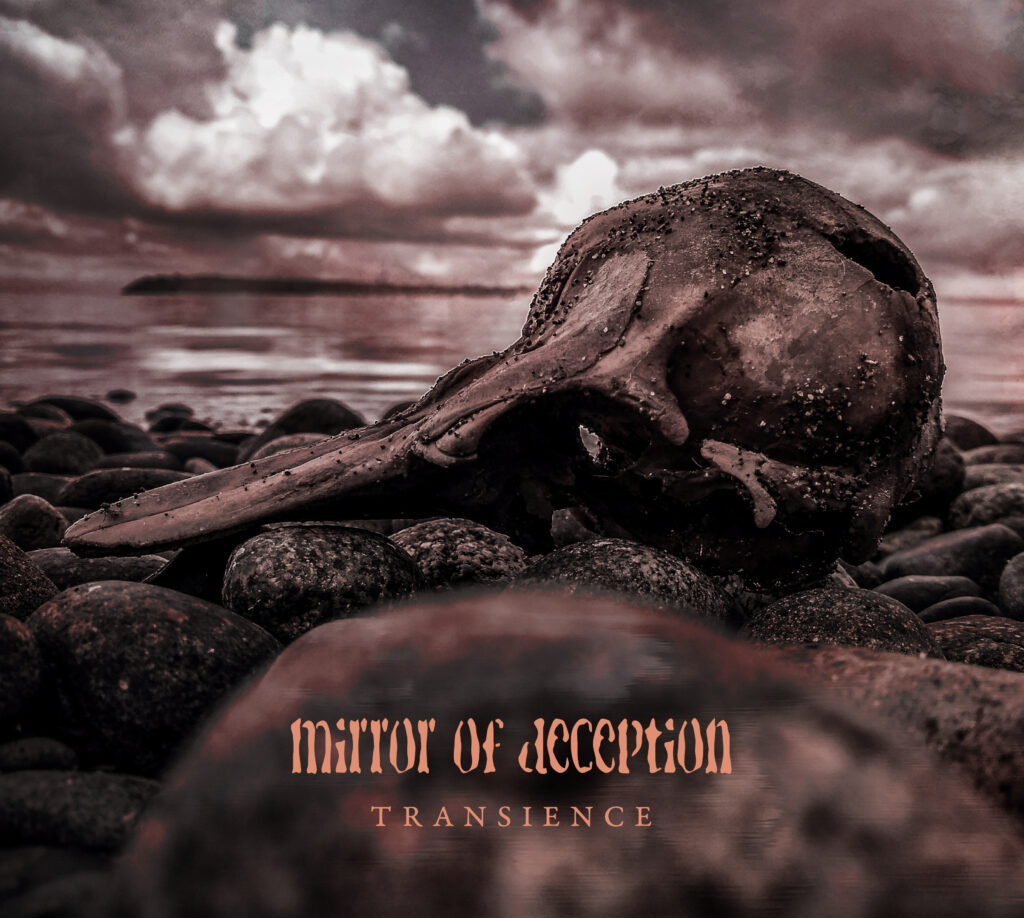
I rarely write album reviews here, but Mirror of Deception’s new release justifies an exception. Eight years after their last full-length album, The Estuary (2018), the German legends of doom metal released just this March Transience. The record is receiving widespread recognition from critics, both in terms of the number and coverage of the reviews as well as in terms of ratings and comments. As I write this, I have counted at least 24 reviews of the album in languages such as German, English, Italian, French, Polish, Spanish, Greek, and Hungarian, all of which practically unanimously shower the band with praise. To hopefully add something to this body of reviews, I will combine comments on the album itself, a non-systematic look at the other critiques, and some memories from my personal history with the band.
Although the band has been around for over thirty years, I only heard of them when they were announced as one of the headliners for Doom Over Vienna in 2024, a show that our Steäm Machine reported on in this very blog. During the days prior to the festival, I listened to some tracks from Mirror of Deceptions’ discography, mostly from the aforementioned The Estatuary and Foregone (2004), which include some terrific songs like “The Ship of Fools” and “At My Shore”. And then, once at the festival, I had one of those experiences that can only be described as an epiphany. If I remember correctly, toward the end of their set, the band performed their latest single at the time, which, for reasons I cannot fully explain, just grabbed me right away and has accompanied my everyday (real or imagined) sounds ever since. I am talking about “Slow Winds”, the fourth track of Transience, which Pascal and Jochen from the band describe as “the heart, soul, centrepiece” of the album.
A review written in Polish by Gruz Culture Propaganda (thanks to online translators!) points out two key elements of the song: on the one hand, its sadness and bitterness, and, on the other, that it has something transcendent about it. Indeed Jochen, one of the founders and guitarists of the band, shared with me in a personal communication that the song was inspired by the story of “Ötzi”, a natural mummy from the Copper Age found in South Tyrol,* as well as by solo hikes and views of the Andes and the Alps. In this context, the colossal nature paves the way for a sense of human insignificance within the cosmos (as a form of intrascendent transcendence) as well as for themes of farewell and escape that are also pervasive in the song. These lyrical elements, naturally, work in tandem with the heaviness, slowness, tightness, clean vocals, and harmonised guitar melodies present in “Slow Winds”, carrying, as a review published in Metal Underground Austria suggests, the atmosphere of introspection and resigned melancholy to its furthest consequences.
As the Hungarian webzine Femforgacs rightly notes (thanks again to the translators), the album is by no means monolithic. Instead, amid the band’s unorthodox doom sound, we can find a wide variety of riffs and tempos that even approach mid-tempos, such as in the album’s opening track, “Death, Deliver Us”.
The song is based on the seventh chapter of Bram Stoker’s Dracula, which narrates the last voyage of a terrified and doomed crew trapped in the fog and even includes a direct quote toward the end: “She must fetch up somewhere, if only it was in hell”. Sonically, the song draws on harmonised guitars, signature of Mirror of Deception, and a moderato drumming that switches the accentuation of the snare between beats 2 and 4 in the intro/choruses and beat 3 in the verses. The vocals, as the review of Locky Rocky notes, offer dramatic moments including clean, whispered, and almost guttural passages towards the end which, in my view, fulfil their purpose as the “lyrical singer” representing a ship’s captain without breaking with the conventions of the genre. Although it is true that some reviews hold different opinions on the matter. In any case, “Death, Deliver Us” plays with supernatural horror themes to explore broader tensions between doom and the struggle to survive. In the midst of this conflict, the song reminds us that, at least for now, abandonment triumphs even against the most desperate plea for mercy: “No sign of god; he deserted us.”
The entire album is definitely worth listening to, and it includes some landmarks such as “Haven”, a fantastic song that is also the first one in the band’s entire history featuring guttural vocals. I would like to comment here though on one last track, precisely the closing number, “Meander”. As we already observed with “Slow Winds”, archaeological references are quite present in Mirror of Deception, a theme that returns in “Meander” to reflect on the human condition and the spiral of violence that seems embedded within us. The track’s lyrics address a recent archaeological discovery, the Tollense Valley Battlefield, a site where a brutal battle or, perhaps, a massacre took place during the Bronze Age, resulting in hundreds or even thousands of victims. The song not only narrates the event but also the very process of finding the bodies buried and hidden by nature, which began to be exposed along the shores of a peaceful river. As Jochen states in an interview, the song “is a testament to the fact that people have always been good at harming and killing each other, driven by greed, jealousy and hate. But even if time forgets, everything will come back to light at some point”.
“Meander” is the most ethereal and calm song on the entire album. Some reviews describe it as “mysterious,” “dreamlike,” or even as a “sprawling atmospheric masterpiece.” And indeed, the song is built around an arpeggiated bass melody, gentle drumming, and almost whispered, evocative vocals. The clean guitars, continuing this atmosphere, provide some counterpoint melodies. The track builds in intensity just past the 2:30 mark with distorted guitars and more prominent (yet still slow) drums, just as the lyrics proclaim: “A shard of a skull emerges”. It is a reminder that the most horrific events of the past still continue to haunt us. Towards the end, “Meander” returns to the same apparently calm initial atmosphere, yet one that contains within it (though not at first glance or listen) everything we have already heard in the track, on the album, and throughout our entire lives:
“The peaceful stream continued to meander
to seek new paths.
To bury new secrets
Or reveal some of old”
Mirror of Deception has gradually become one of my most beloved doom bands, and this album just reinforces that personal inclination. The band recently performed at the legendary Doom in Bloom and the Easter Darkness Festival in Sweden, and currently has two dates scheduled for the rest of the year: on June 19 in Weikersheim, Germany, and on September 26 at Styigian Pilgrims in Braunschweig, also in Germany. I will do my best to be there, but a short trip of the band to the so-called Musikstadt is not a bad idea either.
*For those interested, I highly recommend the short but insightful anthropological analysis by David Graeber and David Wengrow of Ötzi and his counterpart, Romito 2, in The Dawn of Everything (pages 11–20).