
Off The Stage – Pt. 5 – (English)
Translated from Spanish. (Para leer en Español, aquí)
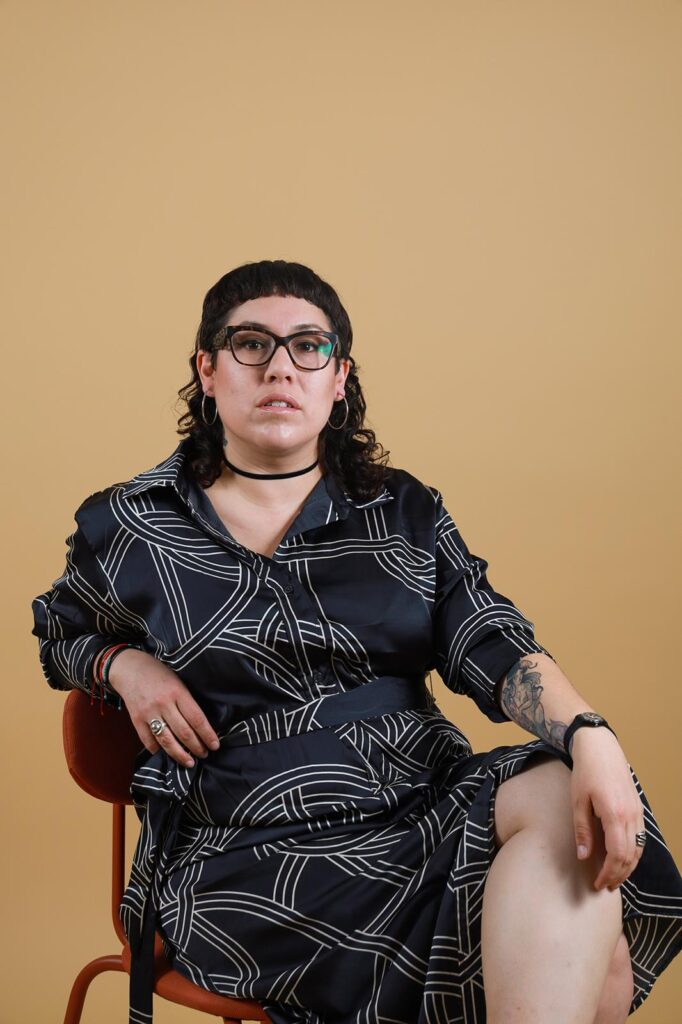
Cynthia Flores. Cyn has been a key figure in the formation and development of the Mexican music scene, expanding its reach and showcasing a different approach. With unparalleled commitment and talent, she has played a vital role in strengthening a music scene that has sometimes been quite down.
In this conversation, she shares some of her motivations and goals for achieving all of this. With the utmost respect and admiration, I share this fifth edition of Off The Stage.
SoG: Okay, let me quickly tell you what I’m doing. I came up with the idea of doing a series of interviews with people who are behind the scenes, which I called Off the Stage . And the intention is to shine a light on these people who aren’t necessarily performing on stage, but who, through their work, time, and other contributions, drive the music scene. And since I didn’t want to focus solely on the Vienna region, I’m including people from other places to provide a more global perspective. At the end of the series, I’d like to explore the similarities and contrasts between the experiences and motivations of all these people and their work.
And obviously, when I thought, “I want to include someone from the Mexican scene“, it felt super natural to talk to you, because obviously your career is insane. I mean, you’ve done everything, literally everything that can be done behind the scenes. And it was like, “Holy shit, I absolutely have to contact her“.
And also, you also have some experience in Vienna, because you came with Mengers when they played here. And so, after thinking about it a bit, it was like: “Damn, I have to have this great woman here with us“.
Cyn (C): Oh, thank you so much.
SoG: Nothing to thank for! Your work is super admirable. And what could be better than if this can bring a little more focus to the work being done elsewhere? That would be awesome. And who knows, maybe more opportunities will come out of this, or the Vienna scene might be inspired by your work, I don’t know, but I thought it was really cool to have someone with your profile here.
C: And you know, in recent years I’ve been very connected with other countries and other artists. I mean, life has led me there; it just started happening on its own, connecting to see what else we can all do outside of Mexico, especially as artists… I see a similarity in technical, operational, and psychological situations.
SoG: Yes, sure. Or even other challenges. Which I also want to see {with Off The These} the differences between scenes/markets, because I imagine it’s very different doing this in Mexico than doing it here {in Vienna }. I mean, there are simply different opportunities, and openness, and…
C: And ways. Yes, it’s been interesting, but let’s see, tell me…
SoG: Okay, so to kick things off, I’ve been playing a thought experiment that offers some insights into you and your motivations. Here’s the scenario: Let’s assume aliens exist and have come to Earth to restructure everything in the world. They’ve been studying humanity and are convinced that the arts, creativity, and so on are what distinguish us as a species. And somehow, they happen to be flying over Mexico City. When they land, they find you and ask: What do you do? What’s your profession?
C: Ah, well, I dedicate myself to finding opportunities for artists, to seeing how we can make music have the relevance it deserves in humanity. The relevance and respect it deserves.
SoG: Of course! Yes, respect for the artist’s work! This is very important.
So, based on that, the aliens say, “Okay, you’re going to be the human representative for the arts and music“. And as that representative, it’s up to you to decide how you’ll restructure the music scene.
C: Uh, dude. No way.
That’s the million-dollar question. And precisely because my ideal is to seek out respectful work practices, I think that in many sectors that’s the problem: we’re in a super-accelerated system of consumption.
So, music has always been heavily exploited and abused, like any natural resource. It works {until} too much is extracted without giving anything back. In other words, it’s not sustainable because we don’t give anything back to the key elements, {in the case of music}, to the human element…
SoG: Of course. It’s just exploitation.
C: Yes. At the beginning, when I started my professional career, I think I was very naive.
But over time you start to see things like, “Wow, why isn’t this happening?” And I think it also depends a lot on people’s profiles and perspectives, because unfortunately, in order to comply with this economic system, we fall into desperation, as managers or musicians, thinking: “What do I do now? How do I come up with things to make it big, to get people to listen to me?” All of that suddenly creates a cloud in your head of things that lose their meaning and then cause you to lose focus.
[Cyn Flores by @bereriveraofical]
And many of us who work behind the scenes started down a very innocent or naive path, thinking, “Oh, it’s all about the music“. And that’s perfectly fine. The problem is when people lose sight of it … {when} they truly lose sight of what they initially wanted: ” to support artists“. But when you want to stay within a certain circle, perhaps to become famous, people suddenly lose sight of what they’re looking for, even the ways of working; you start modifying them to suit your own convenience, and that, for me, has been grievous. When I see how people, in their pursuit of more and more, lose that focus on the mission they had at the beginning…
I think it’s vital to be very aware of your mission, what you want, and what you’re passionate about. So, if I had the chance to redo things, I would remake a community with fairer conditions, and I would ask the aliens to please keep people’s consciousness more stable, more solid.
SoG: Right, staying true to what initially led us to get into this “industry”, which I don’t even like to call an industry, because I feel like that’s part of the problem, right? Seeing {art and music} as an industry and not as a fountain of inspiration…
C: Yes, it is accepting that we are within a system of mass consumption and production and that everything is like this.At breakneck speed, against the clock, so that people buy, buy…
And so, one gets a little confused, both in managing spaces and in doing what you want to do to support the community of artists who have the quality or the dedication to develop it… Because it’s not easy, I mean, you listen to a structured composition, and you say: “Wow, how did they do that, dude?! “… So, you have to value that ability all the time, and keep it in mind… I think it makes you a little more humble to say: “Okay, fine, I don’t have that ability, how can I help you out? ” I think people forget that.
SoG: Yeah, they forget that damn well. And, from my perspective as a “music journalist”, because I do this purely for the love of it, with this very innocent view of: “I’m doing it because it’s what I like and I want to support bands” and so on. But from this side, you see that, the need that this system we live in imposes on you to stay relevant, to keep posting, to even have to put money in no matter what to stand out. And it’s incredibly tough.
I had a question I’d really like to ask right away. It’s about the recent news that Geese used a psyop to flood the media and help their meteoric rise into the mainstream. {And in my opinion}, that’s really messed up. Even with the talent on their side, because they could be a good band, there’s this inequality where those who reach the mainstream or a wider audience are the ones with the money to pay for this million-dollar investment in social media and all that.
This inequality is crazy, {I feel like} the romantic intention of making music and organically reaching people’s ears and so on is being lost, but how do you perceive all this affecting the industry?
C: Well, yes, it’s just that with social media everything has become even more Machiavellian, actually.
I think that throughout music history there’s always been what we call “strategy” for positioning yourself. I mean, the big bands always had a coach or a manager there who would say, “No, we have to do this“, and the other guys {the musicians} were also giving in to something they maybe didn’t even fully understand. Like, thinking about the Beatles, there was this guy {Brian Epstein}, or people who would quickly say, “Well, we’re a team and we’re going to make this a hit “, and BAM! We want millions. Because in the end, record labels have been working and understanding many situations for decades.
Fortunately, a very particular situation with music is that nothing is set in stone. So, now with digital tools, I think they’ve created an even bigger disadvantage.
SoG: Yes. And it’s kind of “hidden.” {And by hidden, I mean} this whole psyop thing that Geese and other bands used, nobody knew there was a million-dollar investment to create bots, to put them on playlists, and so on. And everyone thinks, “Oh, it’s an organic discovery, the band of the moment that we discovered on whatever “, but no, it’s all about the dirty money in the end… I didn’t want to get to this point, but yeah.
C: Yes, that’s true. You know, when I made the decision to start an agency, it was to be more on the side of the artist than on the side of the people who are part of that hype, and that trend which is sometimes very unfair to others.
I think that… the system always tells you something like: “Well, if you have the tools, then go for it“, but that’s precisely what’s Machiavellian, that the end justifies the means is really messed up.
I mean, there are teams that already know how to use the tools… well, call them cheap, or whatever… {I was reading the interview with Geese, I don’t remember the publication} but they were saying that in the end they made music more accessible, and that if it’s quality, well, it has to work, right? Naturally. And they have a point, and from there you get drawn into the question of “what is good music? What is bad music?”, because there are also very complex and unique compositional situations that aren’t accessible to everyone, but that’s what the industry is looking for, those who want this to be an industry that works to be successful, so that if you listen to it you say: “Yeah, it’s good, it’s well done“, …
SoG: And yes, but they can deceive you… they can even deceive the listener, and make us think like: “Oh, well yes, it’s cool, it’s what’s in today“, but the difference is those are who had the money to get there.
And there are other bands that are also behind it, but without the same opportunities and because of that same inequality they can’t reach the ears of the people who might even like them more, right? Or I don’t know.
C: Of course. And you know, right now with that phenomenon of the Canadians, Angine de Poitrine, I just saw a tweet and I was like, “Holy shit, of course, dude“. We have a band in Mexico that’s been around for decades and they’re really badass, they’re a cult band and all that. They’re called La Perra. They’ve been playing incredibly well for ages, and yeah, it’s a similar fusion situation to them. But they’re retired now, but they have the same structure, the same intention…
SoG: Yes. The fusion of rock, jazz, and something else… there it was. [Recalling, math rock comes from experimental rock and the avant-garde]
C: I mean, they’re super viral right now, which is sometimes a necessary evil for musical genres, I think. Because there, for example, there are a lot of people who used to consume a lot of mainstream pop and stuff, and suddenly they stumble across some really weird stuff and it changes their lives because they didn’t know it existed, and it’s like a musical river is created from their background.
And then they go the other way, and that’s appreciated, because in the end, depending on the musical style you’re working in, it’s about which side of the river you want to be on… Because we’re all rowing.
SoG: Uh-huh. We’re all in the same boat, and that effect is very real, but it also depends a lot on a person’s consumption habits…
C: But that’s precisely why social media is a necessary evil. Some people take advantage of those tools, but that’s why I’m saying… that’s just how the damn system is; it forces us to figure out how to do it, how creative we get to avoid needing millions, and how to outsmart the algorithm.
SoG: I agree one hundred percent. {The most horrible thing about the system is that it forces us to participate in it}. And the trick is to play the game, but without sacrificing your principles from the start. It’s like: “Okay, fine, I’m in this because I have no choice, I have to participate in this damn system. Okay, I’m going to use it to my advantage in a certain way without needing these millions, but to continue being creative and putting my work up there and with the best hopes in the world of being discovered or reaching the people who connect with my art”.
C: And in the end, {going back to the aliens}, if they could give us back that naiveté or that sense of purpose all the time, everything would be very different. I mean, people would look for fairer situations or more honesty…
SoG: Agree, and we could delve into those textures for hours, but I’d like to talk more about your work too, because, I repeat, your career is really badass.
I wanted to ask you, what sparked your interest in getting into this? Do you remember the moment you said, ” Hell yeah, I’m going into music, this is my thing?”
C: Yes, the thing is, I’ve been collecting records since I was very young, and I’ve been fortunate enough to have been very involved with music all my life, and I always say it, since I was a kid my dad would make me listen to bands, like Supertramp , Queen … (Yes, my dad was very Anglo-Saxon).
SoG: {Mine too}
C: And then you meet people from Chile and Argentina and you say, “Oh, what is this? A strange state!” So, the thing is that moment in life when you start to see and hear music from a more conscious perspective.
So, naturally I’ve been involved with this, and I’m telling you, even in the thing of having friends in high school who played music and/or female friends, like: “Oh, let’s go and smash, in the afternoon at Susana’s house to watch MTV videos and stuff“.
SoG: Yeah. {Great plan}
C: Well, it’s always been close by. I mean, I think I have sought it out, but I’ve always been like, “Cynthia, she knows these people“.
And the moment I said, “Well, yeah, having a band is going to be a pain”…
{The opportunity to be the bassist in a cool band came up}. I went to my mom and said, “Hey, I’m going to apply and try to audition or see what’s up“. And she said, “No way, what’s that? That’s going to take up your time. Besides, it’s a drug scene… ” and I was like seventeen years old. But obviously, I didn’t even go to the audition. I think I would have been even more rebellious and determined to really dedicate myself to playing.
So, between limiting myself and “what a drag to argue with my mom about going to rehearsals” and all that… it did make the situation of any musician much clearer. All the time that has to be invested, all the uphill battles you have to fight to get it seen as a profession and not just a hobby. Few are blessed enough to have {the chance and support to do so}.
And then I thought about all the ingredients it required. And I said, “Damn, dude, how can I help? What do I do? ” And also, you know, the blog boom was just starting. So, with that natural inclination of, ” Oh, I’m going to write. Ah, I’m going to recommend this“, I still had that nice tradition of consciously downloading each song, ever since I discovered Napster. (I mean, I’m getting old).
SoG: We are. Yes, I do remember those times.
C: It’s like all that passion and care in valuing each song you’re looking for. It’s like you’re doing a very natural kind of research at the same time, like: “Oh, wow, so these guys also have a cover of ‘I don’t know who’ and who is this guy?“.
It’s like all that love for researching, but also “not being stingy” and sharing it. It leaves you in that situation of: “Dude, what do I do? How do I make sure that these songs, which were damn hard to find, are also available to people who appreciate them, like me?“.
SoG: Yes. Of course. {Don’t keep the discovery to yourself, but share it with everyone…}
C: Especially your loved ones. I mean, dude, there are so many memes/phrases like: “You have to appreciate the people who introduce you to new music. Those are the cool ones”. And it’s true. It’s like: “Dude, I’m having a great time with this song, so, dude, listen to it!”.
SoG: Sure. “I think you’d enjoy this too”, right?
C: Uh-huh, “I want us to be happy“. I mean, I’m talking to you from a very hippie side, but that’s because deep down that’s who I am.
“My mission with music: to spread it“
SoG: Of course, times two, 100%. And I feel like it’s a really beautiful act, discovering something and thinking, “Ah, this might appeal to so-and-so“. I think that act is, besides being super beautiful, super noble: “Hey, this thing I liked, this thing that resonated with me, reminded me of you. Give it a listen. I feel like you’ll like it“. That’s a really sweet and noble thing to do.
C: Well, that’s exactly the premise on which I started my little blog.
I don’t even remember anymore, but there was this guy who had a slightly more relevant blog. And when I was in high school, I wrote a review of a Goldfrapp album for him, and suddenly he said, “No, your review is missing this, this, and this“. And it kind of bummed me out, like, “Dude, I’m not a professional“.
SoG: Aha, like: “Dude, I did it for the love of art!”
C: Yeah. So I was like, “Dude, well, I’m going to study communication, I’ll see what’s up, it’s kind of going in that direction“. My mission with music: to spread it .
SoG: Wow, hell yeah, that’s cool.
C: So, over time and over the years, you start seeing more problems, and when you reach a point where you have a different reach to spread and share, you see that you’re really supporting and growing the numbers of a band you loved. And then they come up to you and say, “Damn, dude, thanks for publishing the article about so-and-so. And honestly, I did see how my listeners started to go up and my…” you know?
I mean, I really appreciate magazines and blogs and all that stuff. They’re like my alma mater, but then again, the system is also incredibly precarious when it comes to the media and journalists.
Well, they’ve either stopped existing or stopped printing. A lot has happened, and it’s been incredibly unfair. But you know, “Okay, fine, I’m doing this… I think the greatest connection with a band is seeing them live, in concert“.
SoG: [At a show, of course.]
C: And that’s how I started doing shows. I kind of said, “Well, it’s more about putting them in a space“, and that was also part of my life’s mission. You always need to be very grateful and aware that you can’t do things alone and that you need a team and people with the skills to complement you. And that they all contribute to your true mission.
And that’s also super important and super cool, that you meet people along the way who are on the same wavelength as you and they encourage you to keep your mind racing. To see what things to do and try to make them a reality. Because the truth is, all of us who work in this field have to be huge dreamers, right?
CoG : Of course. Having a certain ambition and a dream of sharing with more people…
C: Well, yeah, it’s like going from “I imagined this ” to, with the team you’ve found, saying: “we have to do it, we have to make it happen“. I think that’s the hardest part, dude.
And sometimes many musical projects fall short of their dreams, even sabotaging themselves to some extent. And that’s where the decline of many bands comes from; they disappear because they limit themselves too much…
SoG: Of course. Well, the famous “imposter syndrome”. There is no worse critic than oneself.
You might be dreaming, but you just don’t dare to make it happen because you start to doubt yourself and you stop taking that extra step to make things happen. And that’s why, again, I really admire your work, because you already have Ascendente, and you also have the MusicMex project , which is also amazing. I mean, you haven’t just dared to dream, but you’ve taken those extra steps, along with other people, obviously, another team and so on, but you’ve achieved it. You’ve put it there with this same vision of: “Okay, let’s share more music, let’s share spaces so that creative people can meet and get started and take this next step“. I also really like and admire that about your career.
Do you remember if there was a canonical moment when you decided to put together Ascendente, for example?
C: Thank you. Yes, well, I think there are two very key situations. One is when I no longer felt a connection with the project I was working on… And the other is because I believe that projects always have to have a lot of heart, more than ambition… And naturally, things will work out for the best, for the benefit of everyone, rather than for the benefit of a select few.
And also, after working at an amazing festival, which I really enjoyed, I saw how a lot of things happened with the bands after that, like it motivated them to say, ” Dude, I want to be there, I want to play there, I want to… “. I mean, it is possible to have such an awesome day where we’re all really enjoying what we love. I think there are several of us who are doing our part to create festivals and events that are relevant to the small communities that exist.
SoG: Yes. Of course. {On all fronts}
C: And that makes them grow, here and in any city in Mexico, small, large, or medium-sized. Another part was that, because of my past work, and I have to be grateful for that, I started getting more requests to go to these music markets. I didn’t know what a music market was. I mean, the one in Guadalajara has been around for {several} years, and I only went a couple years {because I had a lot of work and couldn’t make it}. The first one was in 2019, and it was a turning point, making me realize many things in my life. And one of those things was that I was invited to Chile, and they needed profiles of women in the Mexican music community. And no matter how much I said, “No, no, no, but the owner and the director is someone else“, they told me, “No, we want you“. And from then on, I went, and my life changed completely.
So, I started to see other perspectives. I began talking to other people who were in the same situations as me, but in different ways because they were in another country, and that’s when my mind kicked in. I swear, after that trip to Chile, I came back and said, “Damn, everything we have to process as a music community, we’re moving so slowly, what’s up with that?” And especially regarding the focus on the artist. I mean, you choose these artists, and then what else do you do with them to really support them? How do you give them continuity? I can be doing a million things with a ton of artists, but then what about the long-term relationship with music? Where am I going to have that? And I’m also referring to the artists themselves, how am I going to help those who are working under different conditions… Mmm.
So I said, “I think so, it’s time”. And also, I’d been friends with Descartes a Kant for many years, and they’d already said to me, like, “Hey, do you want to be our manager?” But I couldn’t accept because I was 100% focused on another project… And that happens too, a lot of people say, “Oh yeah, I’ll help you out and all that”, but in reality, they either don’t have the time or they don’t really like the band that much. So then people get left hanging and frustrated. And it’s not easy, because even if you want to support a band, you’re also building a family relationship there…
SoG: Yes, ultimately that’s what it is, {a family/close relationship}.
C: Yes, because the truth is that you can still work at some point {with the idea that} nothing is forever, you can work for several years and contribute and all that, but you also have to have chemistry with the people who make this music…
SoG: Yes, well in the end if you’re going to focus on art and being creative, I think having chemistry or a genuine connection is super important for this to develop.
C: Yes, I think it’s vital. I mean, being honest in these working relationships. And when you’re part of an industry, it’s not so easy to find these people who are truly on your side…
“…music has a rule: nothing is set in stone.”
SoG: Or that connect with you and foster this creativity or this safe space, also, so that you can feel calm and make your art.
C: Exactly. You have to balance several things, because then you’re also building a small team, you’re very independent… But in the end, you’re looking at how to have tools a little more readily available, like Geese’s , maybe not with that budget, but it’s always about constant research to say: “Ah, okay, we can do this and make it happen“.
And we’ll see what happens, because, like I said, I think one thing I’m very clear about is that even if they have the financial resources, it doesn’t mean it’s going to happen, you know? I mean, in a way, music has a rule: nothing is set in stone. So if people aren’t aware of that, well, the bands aren’t aware of that, it also becomes very frustrating… And yeah. I’m dealing with that.
SoG: There, humbly, haha. Of all the languages, you chose to speak the language of truth.
{Getting back to the point} That turning point in 2019 was huge. And I really liked that they were the ones saying, “We’re looking for women in the Mexican community“. And again, talking about imposter syndrome, you’re like, “No, but why me? “
C: “Yes! Don’t play dumb”.
SoG: Aha! It’s really cool that they insisted and in the end you gave in and went, and that changed everything… And now look at the impact you’re having.
Also, the relevance of women in the music community. I had just read a post from an Argentinian magazine, Fulana, in which they shared a statistic that, in Latin America, about two out of every ten positions in the music industry are held by women.
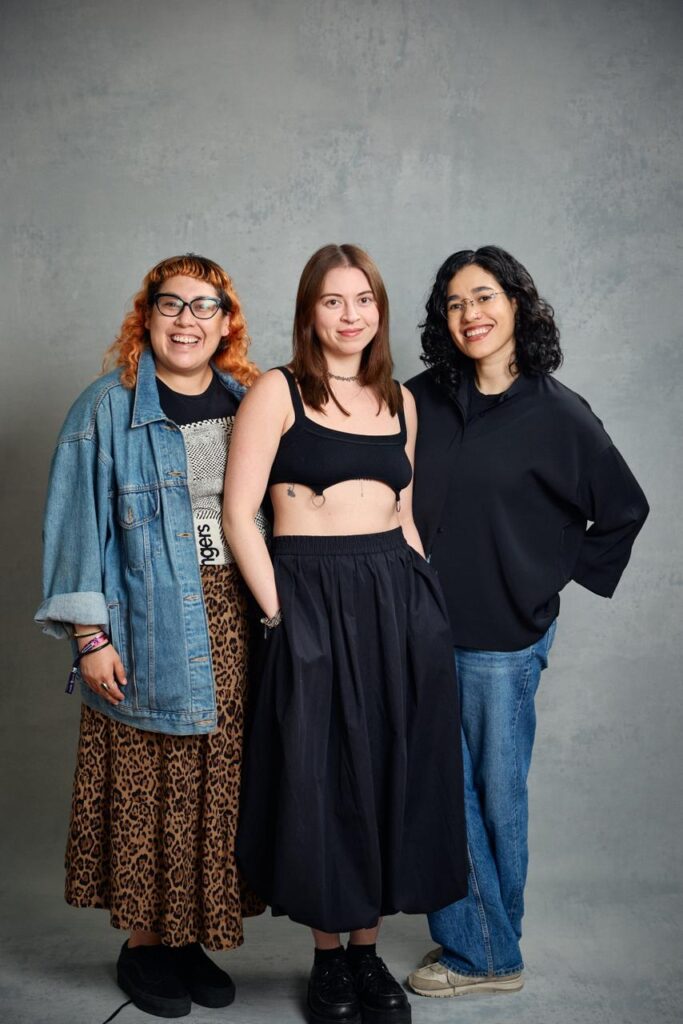
And I see your career path and projects, and at MusicMex you have a team made up of three women: Malfi Dorantes, Valeria Ramos, and you. Breaking this statistic to hell, like, “We’re going to do this”. That’s also super awesome.
Maybe starting in 2019, overcoming your imposter syndrome, and now look where you are, breaking statistics of inequality and killing it in general in the music scene. There’s a ton of work behind it and they’re getting there little by little, but it’s progressing…
C: And there are still things missing, and we’re all in the individual struggle to survive, to try to balance our thoughts, our desires, our expectations. Everyone faces their daily struggles to make their plans a reality…
[MusicMex – Team Cyn, Valeria, Malfi]
SoG: And what they want. But something very important about the things that are missing… there are always things missing in the end. But I think it’s part of continuing to dream, going back to what we were saying, it’s very important to keep dreaming and having this vision with your heart leading the way before anything else, but to have this vision, to keep dreaming and keep thinking. And right now, from the conversation we’re having, I think it’s part of your essence.
You have to overcome that imposter syndrome, and it’s not about believing your own hype in the sense of saying, “Oh, I’m the best and nobody deserves me anymore“. But believing in yourself in the sense that your work is really awesome and admirable. And I’m not just talking about myself. I mean, your work is there and it shows.
C: Oh, well, thank you very much. I hope that when we’re back on tour again, with Mengers, with Descartes a Kant, and those who are trusting in my work and allowing me to move forward with all this…
SoG: And that they align with your ideals and your dreams.
C: Yes, that it’s more in tune with all of that. Because also, and I hate to say it, but we’re part of this damn system, and the key is to go against the current, being creative, figuring out how to develop projects that allow us to invest in music. We have to be looking at options to make it happen, especially in Mexico, where we don’t have the government support that other countries do. But one way or another, we have to be very skillful to promote the projects that are being made with heart and quality.
SoG: And government support is so important. I think it was just this year that Ireland approved a basic income for the arts. Imagine how amazing it would be if we had something like that in Mexico…
C: Ah, well, we should tell the aliens that too, huh?
SoG: Exactly. It’s a very relevant thing to say to the aliens: “Dude, we have to guarantee a quality life for creative people {and all the people}, so they can dedicate themselves to their work… “
C: So that there is a better world.
SoG: Yeah, hell yeah! They shouldn’t worry about trying to survive and should just focus on creating…
C: Yes, well, it’s more about respecting people’s calling. Because, the truth is, unfortunately, there are many musicians who are doing other things, less music, and well…
SoG: Yeah. And it’s all because they didn’t even have enough to eat and they had to work at something other than music. It’s a really sad situation, being a creative soul who wants to write songs and because of this messed-up system we’re forced to work in just won’t let you. That’s really sad, honestly.
C: Yes, that’s true, unfortunately.
SoG: I’d like to ask you one last quick question before I let you go and get started with your day. I was inspired to ask this question by Susana Medina from Mezclas Abruptas.
Here’s the situation: one day you wake up in the middle of the street, look around, and find yourself in front of your childhood home. You decide to knock on the door, and when it opens, you see yourself, little Cyn . And you have the chance to tell her one thing to ensure that this little Cyn grows into the successful and cool woman you are today. What album/band would you tell her to listen to? An album/band that you’d say, “Don’t miss this, it’ll help you become the Cyn you are today“.
C: Ahm . Well, I think Cibo Matto‘s “Viva! La Woman” would really suit her .
SoG: Wow! That’s awesome. Great, great answer, not that there was a wrong answer, but it surprised me in a very good way. Great album.
… [Insert mental and philosophical rambling] …
And well, thank you so much for the chat, first of all for taking the call and for your kind words. It’s very inspiring to find inspiration in you and your experience, and in the other people who make up Off The Stage, all inspired by the same passion and clarity of what we want, with a touch of that DIY punk spirit. Thank you very much.
C: No, well, thanks to you. I mean, you knowing what I’ve been doing is like, “Hey, dude, I’m not doing so badly“. Everything’s fine. It gives me peace of mind.
SoG: Hell yeah. If there’s one thing I want to leave you with, it’s this praise and recognition of your work, which is admired and respected.
C: Oh, thank you so much. Yes, and just like I have to motivate the bands that work with me, we all have to motivate each other, and you just motivated me. It’s a chain of motivation.
SoG: I’ve always believed that in these small acts of kindness (or in this case, motivation), this same motivation, or act of kindness, helps you motivate other bands, and so you form a chain of motivation that maybe those same bands will use to motivate their friends, their comrades.
So, here we are, building a global scene and a chain of motivation.
C: Oh yeah, dude, that’s another thing. But anyway, I have to go now to get everything up and running.
SoG: Sure. Have a great day.
C: Oh, thank you so much. Yeah, same here. Honestly, it’s so cool that you contacted me. See you.