
Off The Stage – Pt. 1 – (English)
Translated from Spanish. (Para leer en Español, aquí)
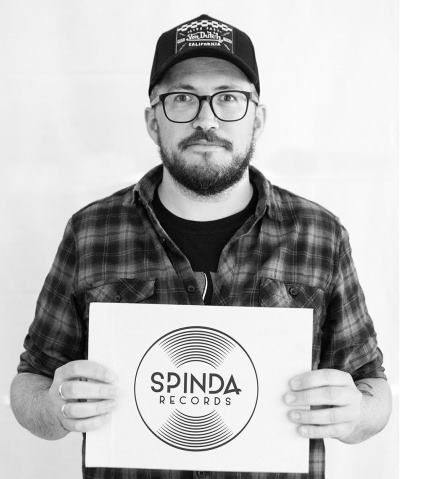
Berto Cáceres. He is a critical figure within the Spanish-speaking music scene, expanding its boundaries with artists from other non-Spanish-speaking regions, creating a community that values authenticity and passion over the standards dictated by the mainstream. Through his work, Berto has not only supported emerging artists but has also helped expand their reach to international audiences.
Below is the first interview in the Off The Stage series, where we discuss the beginnings and career of Berto, director and founder of Spinda Records and La Novena Escena. Without further ado, I leave you with this interesting conversation.
SoG: This interview series is called Off the Stage, and in fact this is the first one. The intention of this series is to shine a light on all those people who aren’t necessarily on stage, but who, with their work, their time, their effort, their passion, drive the music scene.
Likewise, I didn’t want to focus solely on my local scene in Vienna but rather extend it globally. I leveraged both my experience in the Mexican scene and my contacts in scenes from different places. This way, I can contribute a more global perspective, allowing us to find similarities and contrasts in the experiences of all these unsung heroes.
Berto (B): In the end, I’m going to tell you that when the series is over, you’ll realize that everyone is going to tell you the same thing.
SoG: That’s kind of what I imagine. If I take into account my own experience as a promoter in Mexico, I think I have an idea of what we all go through and what motivates us.
B: It’s very similar, and the problems you encounter are practically the same. Obviously, the context changes, the economy changes, the country changes, all that changes. But in the end, almost everything is the same, because everyone goes through the same phases.
SoG: Well, let’s get to it.
Obviously when I thought about doing Off the Stage, you were one of the first people who came to mind. We had talked a while ago about organizing something here. And during this conversation, I think you were the one who mentioned the idea of, ” Well, whenever you want, we can have a chat just the two of us.”
And from then on, I already had it in my mental backlog. And when this idea came up, I was like, ” Of course! The first person I have to call is Berto.” And in the end, it felt very natural, and your availability was something I really appreciate.
B: I’m quite approachable because, as you mentioned before, those of us who work behind the scenes or behind all of this don’t usually have opportunities to talk. So, I think that when someone offers you a space, the least you can do is give them the time.
It’s not every day you get an opportunity to talk, and what you’re going to ask me or what interests you is a completely different approach than if you were talking to an artist. And so, I’m grateful for the opportunity.
SoG: Naturally, what we both love is music. And I think that using this space to highlight all the work behind it is something that motivates me. I want everyone to see that it’s not just the artist who’s working, who undoubtedly works incredibly hard, but there are also many people who love this and contribute their time and effort to make it all happen.
And with this motivation, I wanted to delve a little deeper into the heart behind your label, Spinda Records. What is it that makes Spinda beat Records?
Doing a little research, I saw that you graduated in Media Studies, correct?
B: Yes, I did a Media Studies degree. My degree is a mix of journalism, communication, a bit of design… a mix of a little bit of many things. And then I worked for a while as a television production technician, sound and lighting technician. So, very focused on the technical side. But the technical side wasn’t really my thing.
So, I went back to school and did a master’s degree, this time in Cultural Management, very focused on music. And when I finished the master’s, I ended up working for a city council, managing the cultural department.
That opened doors for me, not only in music, which I did, but also in theater, contemporary circus, dance, and so on. All of this from the perspective of event production.
From there, I moved to a private company, where I continued working in production, but now focusing primarily on contemporary theater and circus. Then the Spanish housing crisis hit, which caught me in 2012. My situation at that company, which I’m incredibly grateful to because I learned so much from it, became unsustainable because we couldn’t get paid and such. It was a rather difficult time for the cultural sector back then. And that’s when I took the plunge and left the arts entirely.
I started working in communications, but in a completely different sector, the video game industry, sports betting, and so on. I mean, it was totally unrelated, but the principles are the same: sender, message, and receiver. Anyway, I worked there for about six years, but as they say, “old habits die hard,” and I was really drawn back to the cultural sector. And in the end, I did return, but this time not working for anyone else, but starting my own company.
SoG: So, what do you think was that moment or experience that made you say, “I have to do this, and I have to start my own label“? I mean, was there a canonical moment when you said, “Okay, this is what it’s going to be“?
B: It’s several things, not just one. At first, I thought it was because I needed to work in the arts again. But then, at the same time, I was trying to become a father, which eventually happened. So, I wanted a job where I could have a lot of flexibility in my schedule, not working little, but having the freedom to work whenever I wanted. Which means you end up working even more. But at least you can say, “Hey, look, I want to work these hours or these other hours.”
At the same time, and this is actually the first time I’ve told this story in any media outlet, magazine, interview, or anything like that; I was suffering from a kind of mobbing (workplace harassment) at my previous job. Then everything came together: the workplace harassment, the fact that I was going to be a father, and my desire to return to the arts. All of that was a Molotov cocktail that ultimately led me to start working independently and founding Spinda Records.
For about a year I combined my day job with Spinda Records. At that time, it was a genuine hobby to which I dedicated two or three hours a day, and I ended up going to bed at one or two in the morning every day. Until the moment came when I said: “Okay, this hobby requires much more time than I’m dedicating to it. If I dedicate more time, will it work? Hmm, I don’t know. I’m going to try“.
And I tried it, basically I quit my job at the other company and went full- time with the label. And that’s it. Even eight years later, I still don’t know if I did the right thing or the wrong thing, because at my previous job I was much more comfortable, I earned more, but I was doing something I didn’t enjoy.
SoG: Of course. [I think many will be able to relate to this]
B: Well, in terms of finances and professional growth, I think I made a mistake, but on a personal level, I think I made the right decision. So, well, I don’t know.
SoG: That leap to do what you’re passionate about is something I admire immensely, and I also wanted to talk about it, or at least mention it, at some point in the series of interviews with the people I plan to interview. That admiration I have for that extra step.
B: I don’t know. The thing is that it’s complicated, Erwin, because look, when you work for an external company, you’re not your own boss. So, you have a certain peace of mind because you know that at the end of the month, you’ll have your salary and that’s it. But when you start your own company or your own business, I don’t know, your dream or whatever, that certainty turns into total uncertainty.
And suddenly there are situations that are completely real, where you might find yourself going three or four months without making any profit; you’re losing money during those months. So, psychologically, it’s very, very difficult to manage. And that’s why it’s always said that entrepreneurs, or people who are self-employed, work at a slightly faster pace, because it’s crazy; you never know if you’re going to get paid this month or not. Basically, you don’t know. But you’re going to get the work done.
SoG: Yeah, sure, and you have no other choice. I mean, it’s: work or die. That’s really tough.
B: Right. So, it’s complex, very complex. And now that you ask me what that point was, that trigger. I’d say those three. But today, looking back, with the perspective that time gives you, I’d say the real reason, and this is something you come to realize over the years, was really the fact that I was going to become a dad, basically.
In other words, for me that was a paradigm shift in my life that made me rethink absolutely everything.
SoG: Yeah, sure. And why a record label? Did you already have that idea or that itch to start it?
B: No, I didn’t have that itch. I mean, what I love most in this life is music, okay? Ever since I consciously discovered music when I was eleven or twelve. I’ve always had music around me, but when you start listening to your own music, that’s what has driven me.
I mean, I’ve traveled to places because of music. My friends, all the friends I’ve made throughout my life, the common thread is music. My hobby, what I collect, are records and magazines. I mean, everything. The books I read are about music. I’m a music fanatic, a melomaniac.
So, for me, the thought that I could end up working and contributing something to that sector was also something that, on a personal level, is incredibly fulfilling. It’s fulfilling because I’m doing something I truly enjoy.
And let’s see, Spinda Records is an independent, super modest label. But I always say that the day I’m gone, I’ll leave with a series of victories. Like, for example, I’ve gotten to work with Jack Endino from Seattle [Mastering of Las Formas de Ondas by Medicina], I’ve gotten to make records for King Gizzard, I’ve gotten to work with Spanish bands that I love, bands I’m a huge fan of, and I never, ever thought I’d be able to work with them. I’ve been at festivals completely behind the scenes and had the pleasure of saying, “Look, I’m watching this band perform, and I’m not out there in the pit, I’m backstage watching it“.
These are different perspectives you gain about music that, if I hadn’t been involved, I would never have had. So, now, I know what it’s like to be able to talk to people I’m a true fan of, and when I talk to them I think, “Damn, that’s amazing“. That kind of thing is very fulfilling on a personal level. It’s like having access to the human side of the industry.
SoG: I understand you perfectly. One hundred percent. I mean, this is a hobby for me right now. And I say “right now” because you never know, right? I mean, because I dedicate my time and passion to this, because just like you, since I was a kid, when I consciously listened to music, I thought: “This is my thing“. And as you say, my friends, my partners, etc., have always revolved around music.
And this is something I also wanted to find in these conversations. Like, we’re all “that crazy music person.” Everything revolves around this, and it’s what fulfills us. And being part of this scene, community, sector, whatever you want to call it, is very enriching, and yes, these are victories you take away.
B: Look, look, Erwin, I’m going to tell you something with complete honesty. To get into music, at whatever level you get into it, you have to be pretty crazy. Because it’s something that’s very passionate. It doesn’t follow rationality, it’s pure passion. Because if you stop to think about it all coldly, you say: “It doesn’t make any sense“, it doesn’t.
But now, the problem is that you can understand music if you’re a musician; you can understand music that ‘s in eighth notes, sixteenth notes, in this rhythm, this pattern. But I’m not a musician, so I understand music from here [points], from my head and my heart.
So, if you get into that field in any way, whether as a hobby, as a job, whatever, it doesn’t matter, you have to be a little crazy because it just doesn’t make sense. But, nevertheless, the people who do it enjoy it incredibly.
SoG: Yes, of course. What drives us could be that same passion and madness that we have for this.
I mean, it’s a blind love for music that’s like, “Of course, I want to do it“, you know? Sometimes they ask me, “But what do you get out of it?” Well, I get the satisfaction of talking to super cool people, really awesome, interesting, and creative people. And with that, I’ve already won. And then they insist, “But you don’t make any money from this“. I know, but it’s not about money a lot of the time. Well, because I’m not doing this professionally, and we’ve decided not to monetize it.
But when you take this step that I admire so much in people like you, it’s not just a passion anymore; there may be times when you’re having a really tough time and you’re not making any money.
So, in this self-management, it’s always that ideal that many of us perhaps yearn for. You even describe the label as a one-man indie label. But in practice, did you face it all alone?
I can imagine it was all part of a support network, people just as “crazy”, let’s say, as us, who helped you build it. Tell me a little about how it was.
B: Behind Spinda Records it’s just me. There’s no one else, and there never has been.
But when you start something, just like if you start, for example, collecting coins or something, there’s an initial phase where you have to ask a lot of questions and read a lot. Because you have to inform yourself and educate yourself. So, in that first phase, I asked a lot of people.
I would ask the underground bands I liked, “Hey, how does this work? How do you do it? Or, when you work with a label, what’s that relationship like? What does the label do for you, or what do you do for the label?” And then, little by little, I started copying and adapting things.
Some things work for you, others don’t, and you discard them. There are others you know you have to do, but you don’t because you lack the knowledge. And then in the end, you end up working with a network of people, but they’re not exactly part of the brand.
SoG: I think this also aligns very well with the artists’ perspective. Often, when I interview musicians, the point comes up about the importance of building your team, your network. Not necessarily part of the band, or in this case, not necessarily part of Spinda Records, but it is this community that exists and where they know each other so well that there is an almost quantum connection of the brain where everything flows.
B: Right. It’s a bit of a difference between being independent. Being independent isn’t the same as DIY (do it yourself). They are different things. DIY for me means you do everything.
And Spinda Records isn’t a DIY label, it’s an independent label. And by independent, I mean that I don’t follow the established rules and that I’m the one who decides the label’s direction, one way or another.
Within that independence there are things that are totally do it yourself and there are other things that I outsource.
SoG: I also remember, I had read in Spinda’s description, that you describe La Línea as a town where nothing good usually happens.
And it reminded me of a personal experience, where I was in a town where nothing good ever happened, and that very thing pushed me to do something [to make things happened].
How do you think that environment has affected or shaped the identity of what Spinda Records is?
B: La Línea is a town in southern Spain that is in a very strategic geographical location because it is basically at the gates, it is on the Strait of Gibraltar.
It’s a very small city, with sixty or sixty-five thousand inhabitants. It has a lot of beaches, it’s cheap to live in, and it’s small, so everything is very manageable.
And then, when I came to La Línea, I was also very clear that what I was looking for was to slow down. To lower the number of revolutions per minute at which my life beat.
How has that affected the label? Well, it affects it a lot, for better and for worse. Because {in the case of music} in Spain everything is centered in Madrid and Barcelona. If you’re outside of those cities, everything is more difficult. Even simple things like promoting an album. If I were in Madrid or Barcelona, I’d hold a press conference, or an album launch in a record store with media outlets, I’d make sure the top media were there, etc. From here, I can’t do that. I can do it if I go to Madrid, but it takes me six hours to get there. Barcelona is even more complicated, because it’s twelve hours.
So, when you live on the outskirts, on the periphery of everything, you limit your opportunities. But at the same time, it also gives you a lot of freedom, since nothing directly affects you, because living so far away from everything gives you freedom of movement.
So, if I were in Madrid or Barcelona, I’m sure Spinda Records would probably be bigger. It would probably also have a much more defined editorial line, because I would have definitely found a goldmine in saying, “Okay, well, I’m going to go for this style of music“. But because it’s what works for me financially, I might have been more easily corrupted by money or something like that. But being completely outside of that, in the end you just do your own thing.
To give you an idea, here in La Línea there might be a concert every two or three months, and the ones that do happen are usually because I organize them myself. So, you don’t waste so much time following rules and patterns; you have a bit more freedom. And at the same time, I also think it’s wonderful because of the decentralization. Not everything has to happen in Madrid or Barcelona. I mean, small towns and suburban areas also have the right to have culture.
Ultimately, it’s very comforting, because every time I do something in the city where I live, the people who like music obviously know what I’m doing, there’s a kind of feedback loop. … So, it has an impact, a huge impact.
SoG: Definitely, both the identity and independence that you value so much about your label. You can decide the direction or path you want. And I also think that’s noticeable in the pool of bands you have. I imagine at first you were very clear about: ” Well, this is what I listen to, these are the bands I like“, but I also think it’s really cool that you’ve turned your attention, for example, to Latin American bands, like Las Finde. Now you also have…
“…when you’re an independent label, you have to release something you believe in first.“
B: Las Robertas, Adiós Cometa, from Costa Rica… Look how curious, when I started with Spinda Records, in fact, during the last week of November 2017, I made a list of thirteen bands I’d like to work with. Of those thirteen bands, I ended up working with all but two. One is basically a band from nearby called Atavismo. And even so, I ended up working with them on a split, but well, I haven’t released any albums of theirs. And then there’s another band, Arena, a band from the Basque Country that was going to release their latest album, but before we could release it, they broke up. So, well, that’s where things stood, but I also got to work with them on a seven-a-side. inches split. So, well, I can honestly say that I’ve worked with all thirteen of those bands. Which is also something you take to your grave. You say, “Damn, you made a list from the start and I ended up working with all of them!“.
And, let’s see, regarding the editorial line, Spinda Records doesn’t have one. There isn’t one, it doesn’t exist. Why? Well, if anyone looks at the first references in Spinda Records’ catalog from 2017, 2018, 2019, 2020, up until the pandemic, people will say: “Damn, this is a heavy psych and stoner label“. And I’ll tell you: “At that time, that was the music I listened to the most“, even though the music I’ve always liked the most is grunge, Britpop, shoegaze, alternative rock. That’s what I’ve always liked the most, and what I like the most, in fact, today.
However, opportunities arise, or you seek them out, and you start working with other bands from different genres, like dream pop bands, post-hardcore bands, or bands that even incorporate jazz elements, all sorts of things. So, right now, I’d say Spinda Records’ catalog from 2024, 2025, and 2026 represent much more of what Berto Cáceres is. My tastes, but not my current tastes, but my general tastes, my tastes as always.
And so, when you’re an independent label, you have to release something you believe in first. Because if that record doesn’t captivate you, there’s no point in getting involved, because you won’t do your job well. So, as my tastes change, there are certain genres I no longer identify with. Just like maybe in ten years, if I’m still alive, I might not be releasing any dreampop and I’ll only be releasing jazz. I don’t know why, but that’s the freedom that independence gives you.
Then, regarding the Latin America thing you mentioned, that was really interesting, because I started working with a band of Argentinian guys called Les Nadies. Actually, they don’t exist anymore, but they were Argentinian, though the main songwriter had moved to Barcelona. And through a forum called Doomcharts, a forum kind of all stoner rock, really heavy psychedelia, all that kind of stuff. Well, I came across a review of an EP they’d released. And then I contacted them and said, “Hey, look, I’m interested in releasing this on vinyl, but do you have any more tracks, so we can complete it and release an LP instead of an EP?” They said, “We don’t have any more tracks, but we can do two more in three or four months“. So, that was the first foreign band I worked with, let alone from Latin America, from outside of Spain. So, well, that was it, just a one-off collaboration.
Fin del Mundo came up, which was super organic. I mean, I saw the KEXP session, like so many other people. And I immediately messaged them on Instagram saying, “Hey, I love what you do and I’d love to work with you“, basically. And we started working together. That’s how it was, super natural, organic. [More on this story in our interview with Julieta – Fin del Mundo].
And well, when you start working with a band, a bond forms, those WhatsApp groups where you talk about things that have nothing to do with the band anymore, but rather about music, personal things, and so on. And as a result of working with them, and them starting to tell me about Latin American bands, and me starting to handle press for them, I was exposed to a lot of Latin American bands.
And then I came to the conclusion that Latin America is amazing, both what’s there and what’s yet to be discovered. And I’m not just talking about South America, but Latin America in general. The sheer amount of music there, with its incredible production and sound quality, is simply unbelievable.
And well, I started working little by little with more Latin American bands and the reality is that today a fairly significant percentage of Spinda Records’ roster is made up of Latin American bands. And it’s not that I’m trying to replicate the success of Fin del Mundo, because that’s not the point, that’s not the objective, but since I work with bands I like, if I’m now getting a lot more offers from Latin American bands than from Spain, well, that’s just how it is.
SoG: That’s beautiful, and that’s cool. I mean, would you say that this relationship you have with Finde is a symbiotic relationship? Because what I see is that they exploded not only because of KEXP, but also when Spinda Records signed them and released the vinyl, and from my point of view it was like, “Wow, what’s going on? They have physical copies now, they have clearer communication“. And then…
B: Well, I think yes and no. Fin del Mundo, I think they were going to explode no matter who they were with, okay?
SoG: Yes, with whomever, of course.
B: Yes. And if they had decided to go it alone, they would have exploded too. But they exploded the moment the KEXP session came out; that’s when they exploded worldwide. But then, for example, there’s a before and after when they start touring Europe, because suddenly a lot more people know them.
So, I think it was a combination of things, they made a tremendous KEXP, spectacular. From my point of view, it was the best of them all. It came at a time when people were in need of many things, and it was like the culmination of a kind of music that many people had been listening to, but hadn’t been able to see live because the band couldn’t tour.
And then in Europe, at the time they signed with Spinda Records, things change a bit too; they came to Europe and did very well, and when they returned to Argentina, they came back bigger than they were before. And I imagine this happens everywhere.
So, I think there’s a kind of constant feedback loop between all the parties. But what made Fin del Mundo explode? Their music. Their music and, secondly, KEXP.
SoG: Sure, {their music first and foremost}. But I was referring to a symbiotic relationship because, let’s start from the premise that this relationship existed, it could have been with one record label or another. But it happened with Spinda Records.
And the moment they arrive here, things go incredibly well for them, thanks to the distribution Spinda provides. But as you mentioned, with this daily interaction, the bands you discover through them, or through their feedback, enrich the label. That’s what I mean by it being symbiotic, a two-way street.
B: Obviously. It’s feedback, because maybe Spinda Records wouldn’t have had access to X bands if Fin del Mundo hadn’t been in Spinda Records.
Today, I can say it without any hesitation, and I think it’s also obvious, Spinda Records has grown largely because it started working with Fin del Mundo. Until I started working with them, the bands I worked with were a bit smaller, and Fin del Mundo opened up the possibility of working with slightly bigger bands, perhaps because it pushed me to my limits. Having to work differently, doing things differently in many ways, while in other aspects I continued doing things the same way as at the beginning, made me realize that with Fin del Mundo I was able to prove to myself what I could do.
So, it’s like I took a step forward, thanks in part to a project I started working on. And that project, in turn, as I took a step forward, also took a step forward. We’ve kind of progressed side by side, more or less at the same time. But anyway, I’m eternally grateful to Fin del Mundo for everything and because I think it’s a band that means a lot to so many people.
On an emotional level, on a musical level, I think it’s a very important band.
SoG: Yes, yes, they’re awesome. Maximum respect and a shoutout to them.
Continuing with this, also in 2023, La Novena Escena was created as a booking agency. It seems like a super natural step to me, after the label and now organizing tours and everything else. What do you think was that moment when you said, ” Okay, I already have Spinda, now let’s form this agency“?
B: From the beginning with Spinda Records I used to organize concerts, working as a promoter. The thing is, it was all very chaotic for me because sometimes I would work with bands on a booking basis that didn’t belong to the label, and vice versa.
So, the moment I started working with X bands… and I started selling concerts to promoters, like a booking agency. That’s when I started and said, “Okay, I have to separate this“. And I was very clear that not all the bands from La Novena Escena were going to be in Spinda Records and not all Spinda Records’ bands were going to be at La Novena Escena.
And I’m realizing that I’m already going through an internal transformation. I’m trying to manage fewer bands and be more involved with all of them. I’m not just talking about booking, but in general.
Because, what happens is, if you manage band X, you handle their publishing, label, booking, merch, management, you handle everything, you can afford to have four or five bands like that and you survive. But of course, my business model was very different; I had many bands to whom I only handled one thing.
So, that leads to you releasing a lot of music every year. There have been years when I’ve put out fourteen or fifteen albums in a single year. That’s crazy for a one-person label. And there were years when I organized six or seven tours, apart from individual concerts, which is also crazy for one person. So, a couple of years ago I thought, “Okay, this is doable, but it’s taking a toll on my health“.
So now I’m in a process of change where I’m trying to reduce the number of bands on the booking roster and the number of bands on the label roster, and work with those bands, but also do more things. That way I can be involved in more parts of the process, moving more towards a 360 deal, as it’s often called, but without being involved in everything, because I’m not going to be involved in everything. But maybe I can handle more things, not just the booking or not just the label.
SoG: Wow. Just hearing about all the work you put in makes me admire your work even more, and that passion that drives you to do all this. It’s impressive.
So, it all stems from this passion and love for music, and in the end, you take it to the point of it becoming your job. It’s something I don’t know directly, because I’m here just as a music fan, or maybe as a “journalist.” Seeing all the work that goes into it is impressive. I mean, admirable like any other job, but it’s very cool.
… [Anyway] just to wrap things up with one last question. Inspired by one of my favorite music journalists, Susana Medina, an awesome Mexican woman. (Listen to Mezclas Abruptas)
The question is: imagine you wake up one day in the past, standing in front of the house where you grew up. You knock on the door and an 11/12 year-old Berto answers, still in his tender childhood. What album would you tell him to listen to, to ensure he becomes the Berto of today, the director of Spinda Records and LA Novena Escena?
B: Uh… When I was eleven or twelve, I mean, we’re talking about 1993-94. Well, I’d tell him to listen to Nirvana’s Nevermind, basically, but I’d also tell him to listen to Deftones’ White Pony. I’d also tell him to listen to, I don’t know, Extremoduro’s Agila, I’d tell him to listen to Björk ‘s debut, Angel Dust by Faith No More, El espíritu del vino by Héroes del Silencio, Fat of the Land by Prodigy, Dookie by Green Day, or Superunknown by Soundgarden, Bubblegum by Mark Lanegan, or Wretch by Kyuss.
But seriously, if I had to tell my eleven-year-old self, I’d say: “Stop messing around and start with Nirvana’s Nevermind“. That’s it.
SoG: Oh, yeah. Or like, “Do you have a pen? Write down this whole list”.
B: Sure, and then when you get to the sixties, or fifties, when you get to the psychedelia of the sixties, the Beatles and all that, when you get to the jazz of the fifties, we’ll talk. Because in the end, we all go through the same journey.
SoG: Yes, we all get there at some point. Of course.
B: Yes, of course. That’s it, everyone, at some point, we all come to jazz and blues, everyone.
SoG: That’s right. All roads lead to jazz.
That’s awesome. Great chat. Thank you so much.
Thank you so much for taking the time. See you soon.
B: Well, that’s it. … Whenever you want to talk, we’re all in the same boat. You’ll have a lot to transcribe.
SoG: It’s a lot of work, but in the end, it’s done out of love and because I want “the world” to read your words and experiences.
Since several bands I’ve reviewed are now part of your label, now it doesn’t stay at a “Shoutout to Berto” anymore… now the famous Berto from my articles has his own place.
B: Anyway, thanks a million for giving me the space… I’ll send you the Las Robertas album so you can enjoy it, and even the Dharma Chain one.
[He did send me prelisten of the albums, which I did indeed enjoy and love. Because I was involved with Off The Stage, I couldn’t review them. But DON’T MISS THEM. 100% Recommended.]